
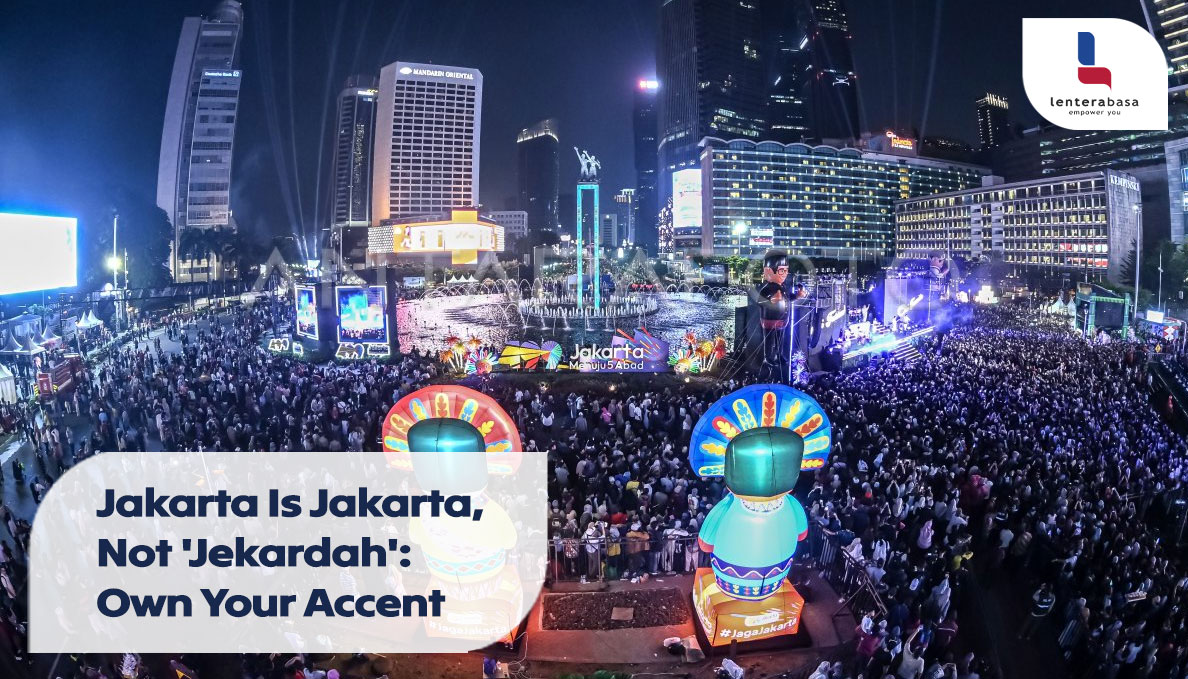
Every 22 June, the city of Jakarta takes on a new look and celebrates its birthday. The streets are adorned with banners, local cultural festivals take over, and the spirit of “Betawi” pride is palpable. We celebrate our identity, our history, and our unique place in the world. Yet, there is a strange linguistic phenomenon that occurs in this city not just on birthdays, but every single day. The moment a local resident opens their mouth to speak English, the city of Jakarta suddenly morphs into “Jekardah.”
It is a curious shift. The “r” at the end of words is softened or exaggerated into a caricature of an American or British accent, and the vowels are stretched in ways that feel forced. But why? Why does our identity as citizens of the Indonesian capital seemingly vanish the moment we attempt to communicate in a global language?
The “Fake Accent” Phenomenon: Why We Do It
The “Jekardah” syndrome of a performative, exaggerated accent is a widespread phenomenon among many Indonesians. It is often a subconscious attempt to sound more “international” or “sophisticated.” Somewhere along the way, we developed a collective belief that to be taken seriously in English, one must abandon the natural cadence of our native tongue.
However, linguists and communication experts often argue the opposite. When an accent feels performed or “faked,” it creates a disconnect between the speaker and the listener. It screams insecurity rather than fluency. It suggests that we are not comfortable with who we are, so we are trying to mask our origins behind a borrowed, unearned identity.
Authenticity vs. Performance
The truth is, your accent is not a bug; it is a feature. It is a map of where you come from. When you speak English, your Indonesian background is part of the flavor you bring to the table. Some of the most respected figures in global business, science, and literature speak English with heavy accents whether they are from India, France, Germany, or Indonesia.
What truly makes you credible is not your ability to mimic a Hollywood actor; it is your clarity and your confidence.
Clarity means your pronunciation is distinct enough that your message is understood without ambiguity. Confidence means you own your voice, your tone, and your heritage. When you stop obsessing over achieving a “perfect” (and often fake) accent and focus on being clearly understood, your authority as a speaker actually increases. You stop being someone trying to act like a native speaker and start being a global citizen who is authentically representing their culture.
The Problem with FOMO-Driven Language Habits
Why do we fall into this trap? Much of it is rooted in a culture of “FOMO” (Fear Of Missing Out). We see international trends, we consume global media, and we feel a pressure to assimilate entirely. But language is meant to be a bridge, not a mask.
When you spend your energy trying to change the sound of your voice, you lose the opportunity to develop the substance of your message. Developing genuine English fluency, the kind that allows you to argue a point, tell a story, or negotiate a deal takes time. It requires a solid foundation in vocabulary, grammar, and critical thinking. Changing your accent won’t make you fluent; building your knowledge will.
Finding Your True Voice
If you want to be taken seriously, stop worrying about whether your “r” sounds like it belongs in New York or London. Instead, focus on these three pillars:
- Confidence: Speak with the belief that your perspective is valuable. Your voice deserves to be heard, regardless of where you are from.
- Clarity: Prioritize being understood. Use proper grammar, avoid unnecessary filler, and choose words that precisely reflect your thoughts.
- Content: Focus on what you are actually saying. A brilliant, well-articulated idea delivered with an Indonesian accent is infinitely more impressive than a vague, empty thought delivered with a forced, unnatural “Jekardah” inflection.