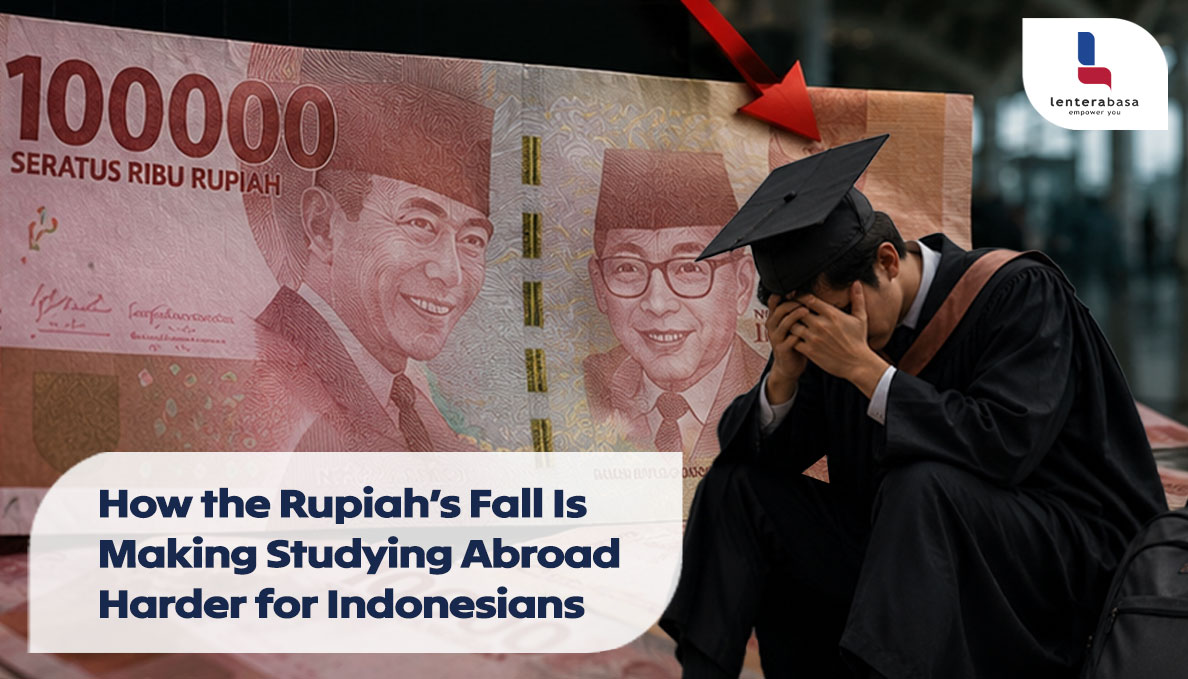
How the Rupiah’s Fall Is Making Studying Abroad Harder for Indonesians
May 19, 2026
-Uncategorized
The weakening Indonesian Rupiah isn’t just a headline for thousands of students dreaming of an international education, it’s a financial wall that keeps getting taller.
Studying abroad has long been a goal for ambitious Indonesian students. Whether it’s pursuing a degree in Australia, the United Kingdom, the United States, or Japan, an international education promises global exposure, stronger career prospects, and world-class academic credentials. But as the Indonesian Rupiah (IDR) continues to weaken against major world currencies, that dream is becoming increasingly out of reach for many families.
The Rupiah’s Decline: A Real Problem for Real Families
Over recent years, the Rupiah has faced significant pressure against the US Dollar, Australian Dollar, British Pound, and Japanese Yen. When the exchange rate shifts even slightly, say, from IDR 15,000 to IDR 16,500 per USD the financial impact on a student abroad is enormous.
Consider this: a monthly living allowance of USD 1,500 in the United States would cost an Indonesian family approximately IDR 22,500,000 at IDR 15,000/USD. At IDR 16,500/USD, that same amount now costs IDR 24,750,000 — an increase of over IDR 2 million per month, without any change in the student’s actual spending habits.
Multiply that across 12 months and four years of study, and the numbers become staggering.
Tuition Fees Feel the Squeeze
Tuition fees at international universities are typically billed in foreign currencies. As the Rupiah weakens, Indonesian students and their families are effectively paying more in Rupiah terms every single semester, even if the university hasn’t raised its fees at all.
A course that costs AUD 40,000 per year in Australia, for example, translates to very different Rupiah amounts depending on the exchange rate. This unpredictability makes financial planning extremely difficult. Families who saved for years based on an older exchange rate may suddenly find themselves short of funds, forced to either cut expenses drastically or abandon their plans altogether.
Middle-Class Families Are Hit Hardest
While wealthy families can hedge against currency risk or absorb the extra cost, it is Indonesia’s aspiring middle class that bears the heaviest burden. These are families who have diligently saved, taken out loans, or relied on scholarships only to see their purchasing power erode as the Rupiah slides.
Many students are now choosing to extend their study period, take on part-time work (where visa rules permit), or downgrade their living standards significantly just to stay enrolled. Others are reconsidering their destination countries entirely, shifting toward more affordable options in countries where exchange rates are less punishing.
Language Proficiency: The Hidden Barrier
Beyond the financial challenges, there’s another layer that often goes unaddressed: English language proficiency. Most top universities in English-speaking countries require minimum IELTS or TOEFL scores. Preparation for these tests requires time, money, and access to quality learning resources.
When budgets are already stretched thin by the weak Rupiah, investing in proper English language preparation can feel like a luxury. Yet without strong language skills, securing admission and academic scholarships that could offset costs becomes far less likely.
This is where focused, affordable language learning support becomes not just helpful, but essential.
What Can Indonesian Students Do?
Despite the challenges, studying abroad remains achievable with the right strategy:
Start early with language preparation. Strong English scores open doors to scholarships and more affordable universities.
Explore government and private scholarships (LPDP), Beasiswa Indonesia Maju, and many international university scholarships can significantly reduce costs.
Consider currency-stable destinations, some countries in Europe and Asia offer quality education with more favorable exchange rates.
Build financial buffers, plan with a weaker exchange rate in mind to avoid being caught off guard.
Invest in certified language courses, quality preparation increases your chance of acceptance and scholarship eligibility.
Take the First Step Today
The Rupiah’s weakness makes it more important than ever to be prepared before you go abroad not just financially, but academically and linguistically. The students who succeed internationally are those who start building their language skills early and strategically.
Ready to strengthen your English for international study? Visit lenterabasa.com to explore professional English language courses designed specifically for Indonesian students aiming to study abroad.